


Roger
Federer
- Biography
- Career Highlights
- Majors
How to best articulate the achievements and meaning of Roger Federer? For the mark he has left on tennis history is both richly qualitative and quantitative. Having plied his craft in the media-saturated 21st century, Federer is arguably the most visible and popular tennis player in our sport’s epic history. At one point, Federer was the second-most respected, admired, and trusted man in the world, trailing only former South African President Nelson Mandela.
One word best explains Federer’s popularity: elegance. Inside the lines, he was as complete a player as tennis has ever seen, the Federer playing style an exceptionally wide rainbow of shots, speeds, and spins, all backed by ballerina-like footwork and balance. Away from the court, Federer was equally cherished for his exceptional kindness. As one of his trademark sayings goes, “It’s nice to be important, but it’s more important to be nice.” Fittingly, Federer won the ATP’s Stefan Edberg Sportsmanship Award a staggering 13 times. On five occasions, he was named the Laureus World Sportsman of the Year.
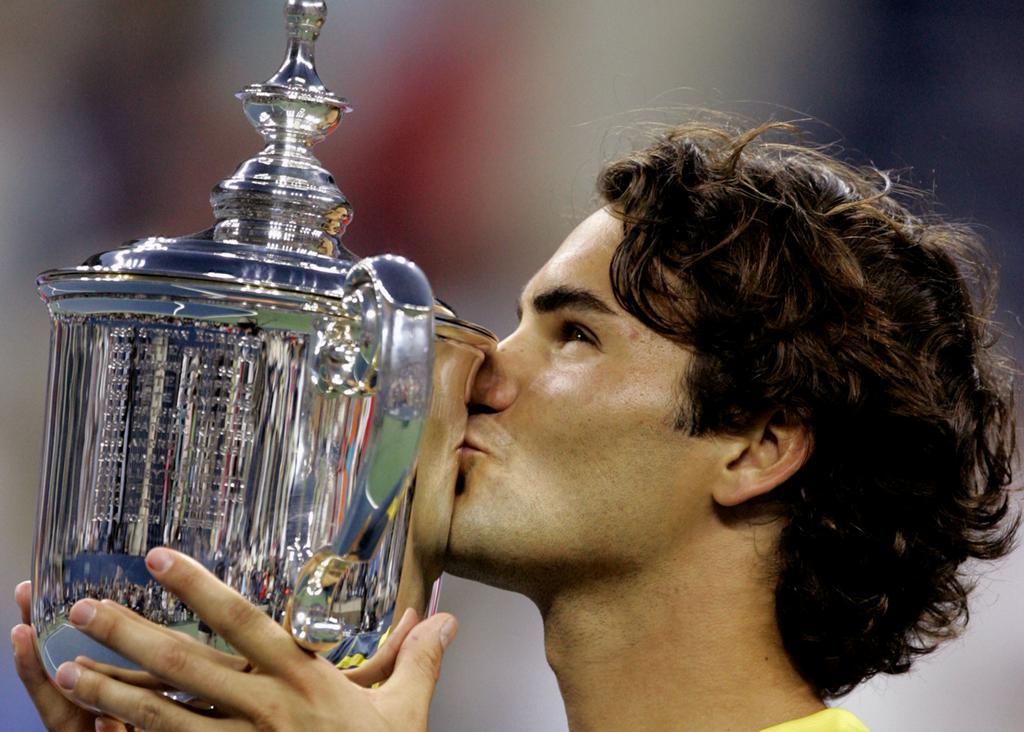
Federer won 20 singles majors — eight at Wimbledon, six at the Australian Open, five at the US Open, and one at Roland-Garros. Victory at Roland-Garros in 2009 made Federer only the sixth man in tennis history to have won the singles championships at all four majors. Federer also held the world number one ranking for 310 weeks, finishing the year at the top five times. And so much more: 103 ATP singles titles, victory in Davis Cup, and an Olympic gold medal, the latter won in doubles alongside his compatriot, Stan Wawrinka.
Throughout these years of brilliant tennis, Federer was the senior member of the iconic “Big Three” — a tremendous three-way rivalry between him, Rafael Nadal, and Novak Djokovic. All told, Federer would play Nadal 40 times (16-24) and Djokovic 50 (23-27). Their fantastic matches greatly boosted tennis’ popularity worldwide.
Coming of Age
Roger Federer was born on August 8, 1981, in Basel, Switzerland. His mother, Lynette Durand, had been raised in South Africa. She met Robert Federer when both were working near Johannesburg for Ciba-Geigy, a Swiss pharmaceutical company. Soon after, the two moved to Switzerland. Their first child, a daughter named Diana, was born in 1979.
Roger first began to hit tennis balls when he was three years old. He also enjoyed other activities such as hiking, skiing, and soccer. Following time under the tutelage of Adolf Kacovsky, Federer, at the age of ten, commenced work with Peter Carter. A former pro once ranked as high as 173 in the world, Carter was from tennis-rich Australia and had been coached by Peter Smith. In an intriguing twist, Smith had also coached one of Federer’s lifelong peers and toughest rivals, 2021 International Tennis Hall of Fame inductee Lleyton Hewitt; after losing seven of his first nine matches versus the tenacious Australian, Federer would win 16 of the next 18.
Sensing young Federer’s appetite for learning the widest possible range of shots, Carter greatly shaped his game, working with him well into his teens. By 1998, the year he turned 17, Federer had become the world’s best junior, winning prestigious titles at Wimbledon and the Orange Bowl. Less than three years after those great accomplishments, Federer cracked the top 20 in early 2001. Several months later, still just 19 years old, the Swiss prodigy hit the global radar in a big way at the All England Club when he defeated seven-time Wimbledon champion Pete Sampras in a scintillating five-setter. This was the only time these two titans played one another in an official match.
A Dazzling Decade
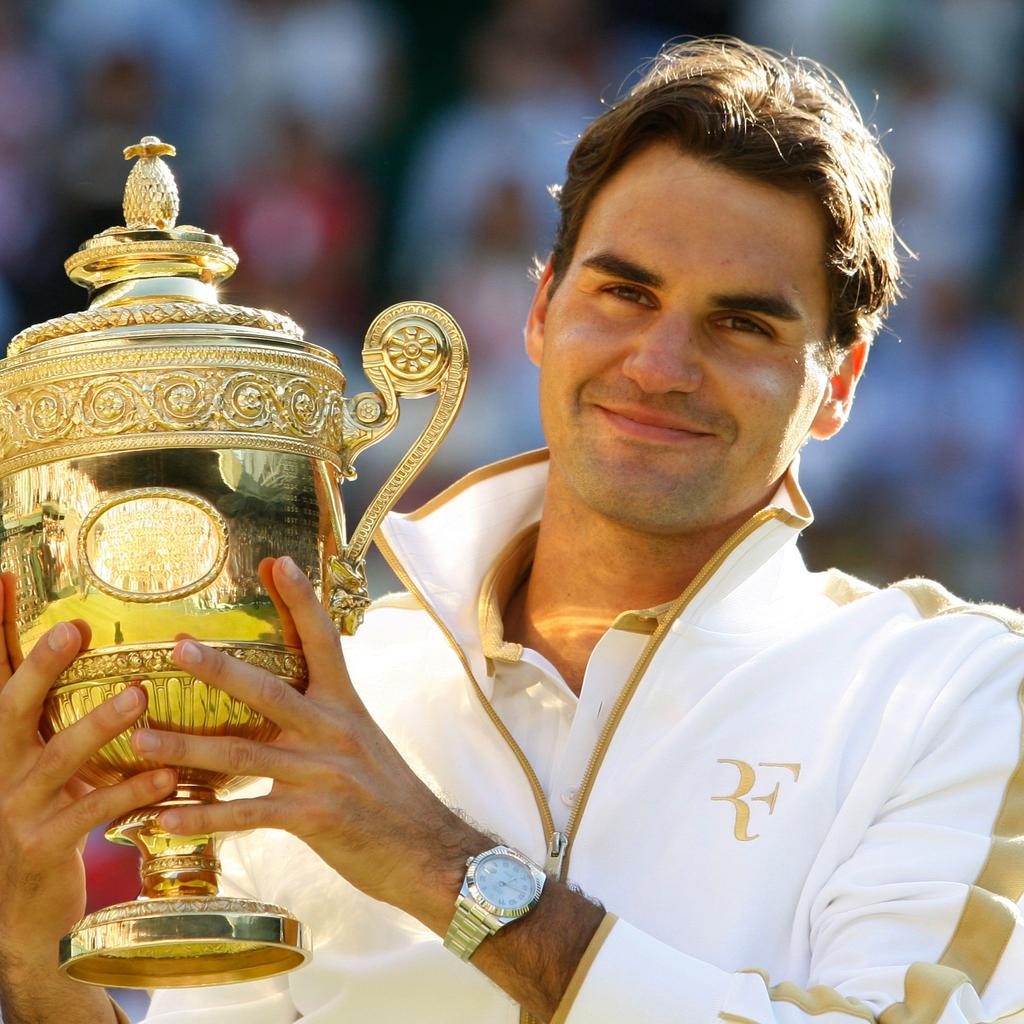
Federer earned his first major in 2003. Fittingly, it came at Wimbledon, the venue he had most loved as a child. Bursting into tears upon earning the cherished title, Federer soon commenced a dazzling decade. Major titles came in cascade-like fashion — three in 2004, two in 2005, three again in 2006 and 2007, two in 2009. An epic Wimbledon victory over Andy Roddick in the 2009 title match — Federer winning 16-14 in the fifth set — was major number 15. Here, Federer snapped a tie with Sampras for the most men’s singles majors in tennis history. By the end of 2012, Federer had won 17 majors.
Everywhere Federer went, he was beloved, largely because of his gracious manners and captivating playing style. Building off the legacies of such silky-smooth male movers as Ken Rosewall, Rod Laver, Manuel Santana, John McEnroe, Stefan Edberg, and Sampras, Federer glided across the court with exceptional ease. From there, he seemed able to make the ball do anything. Able to roll or crack a forehand, carve or drive the backhand, feather volleys and crisply pinpoint serves, Federer built points with exquisite care and creativity. No matter who the opponent was, the venue’s court surface, or the competitive nature of the match, over the course of watching Federer, spectators were almost certain to see him construct and conclude at least one rally in a way they’d never seen before. It was breathtaking.
All of this made fans and legends alike swoon as they had for no other player in tennis history. It also made Federer highly popular among marketers worldwide. His corporate partnerships over the years have included Uniqlo, On, Mercedes-Benz, Rolex, Switzerland Tourism, and Wilson Sporting Goods, the latter of which signed him to a lifetime contract.
A Grand Resurgence
The setting was Melbourne — the occasion: the 2017 Australian Open final. The time on this Sunday evening was 10:45 p.m. Federer had just gone down 3-1 in the fifth set to his greatest rival, Rafael Nadal.
By this point, Federer was 35 years old and had gone more than 4 years without winning a major. Knee surgery had taken him off the tour for the last six months of 2016. Seeded 17th in Melbourne, throughout the tournament, Federer showed off an improved backhand, driving the ball earlier and harder, and surprised even himself to reach the final.
But with Nadal in the lead, Federer appeared headed for his fourth straight defeat in a major final. By this point, Nadal had won 23 of their 34 matches, including all three they had previously played at the Australian Open.
Seemingly out of nowhere, Federer caught fire. Everything from the newly dynamic backhand to his fantastic forehand clicked into a higher gear. Amazingly, Federer rattled off five straight games to earn what was arguably the most redemptive and satisfying result of his epic career. Following that victory over Nadal, Federer went on to win four of his remaining five matches against the legendary Spaniard. In addition to the improved backhand, Federer was also aided by a bigger racquet, having transitioned in 2014 from a 90-inch to a 97-inch frame.
Buoyed by that result Down Under, Federer later that summer won Wimbledon without dropping a set. Back in Melbourne in 2018, he successfully defended his title, and, soon after, was ranked number one in the world for the first time in more than five years.
Federer continued to play excellent tennis, reaching the Wimbledon final in 2019. Later that year, he won his final ATP Tour singles title at his hometown tournament in Basel.
A Distinct Legacy
Beyond his own accomplishments as a tennis player, Federer has made major contributions to tennis both on and off the court.
In 2003, he established the Roger Federer Foundation, which supports educational projects in Switzerland and Southern Africa. As written in its 2024 annual report, “The Roger Federer Foundation wants children affected by poverty to be able to take control and actively shape their own futures.” By early 2026, the organization, now called the Federer Foundation, had helped bring quality education to more than three million children.
Federer also sought to celebrate the game’s history in a big way. Seeking to honor the man he has most often been compared to, the great Rod Laver, Federer and his management team created the Laver Cup in 2017, an annual team competition between Team Europe and Team World. Featuring everything from legendary captains such as John McEnroe, Björn Borg, Andre Agassi, and Yannick Noah, to tributes to Laver and other notables, the Laver Cup was an instant hit.
The Laver Cup was also the scene of Federer’s last match. In London on September 23, 2022, Federer paired with Nadal in doubles to face off against Team World’s Frances Tiafoe and Jack Sock (both of the United States). Immediately following their loss in a third-set super tie-break, the two legends sat on a bench, gently held hands with one another, and began to cry, both men at that moment grateful for all the ways they had pushed one another to one great height after another — a beautiful testimony to the power of tennis to blend competition and camaraderie.
At Federer’s own event, he’d exited in customary style: with élan, eloquence, and emotion.
by Joel Drucker, ITHF historian-at-large
Notable Highlights
- One of only nine men to have earned singles titles at all four majors (joining Fred Perry, Don Budge, Roy Emerson, Rod Laver, Andre Agassi, Rafael Nadal, Novak Djokovic, and Carlos Alcaraz)
- In the Open era, Federer’s 103 singles titles leave him trailing only Jimmy Connors (109)
- 13-time winner of the ATP’s Stefan Edberg Sportsmanship Award
- ATP Fan Favorite for a record 19 consecutive years, from 2003 to 2021
- 6-time champion at ATP Year-End Finals
- 5-time Laureus World Sportsman of the Year honoree
- Competed as part of the Swiss Davis Cup Team for 15 years (1999-2009, 2011-2012, 2014-2015). RECORD: Singles 40-8; Doubles 12-10. Davis Cup Champion in 2014.
- Three consecutive calendar years since the beginning of ATP rankings in 1973 as the No. 1 player (2005-2007)
- Honored as the "perfect ambassador," and became the first living person in Switzerland to be featured on a coin (2019)
- 31 Major Final appearances (20 titles, 11 runner-ups)
- Founder (with partners) of the Laver Cup in 2017. (To learn more about the history of the Laver Cup, please visit our digital exhibit The Legends Behind the Laver Cup.)
20-TIME MAJOR SINGLES CHAMPION
SINGLES WINNING PERCENTAGE (MATCH RECORD 1251-275)

AUSTRALIAN OPEN
Singles

WIMBLEDON
Singles

Roland-Garros
Singles

